

Risk Management · 2025
In this section3 topics
Risk Management Policy & Plan
Main Introduction
The Company recognizes the importance of risk management as a crucial component of good corporate governance principles. It believes that risk management is a vital mechanism and a management tool that will enable the achievement of the company's established objectives and goals, as well as help mitigate obstacles or unexpected events that may arise in terms of profitability, operations, and trust from investors and other stakeholders. Therefore, the Board of Directors has established the following risk management policy for the Company:
1. The Company conducts its business under acceptable risks to achieve its organizational objectives, by integrating risk management into decision-making, strategic planning, business plan development, and various project management processes.
2. Risk management is a crucial organizational culture that must be carried out efficiently and effectively. It is stipulated that risk management is the responsibility of executives and employees at all levels, who must be aware of the risks inherent in their respective departmental and organizational operations, giving appropriate and sufficient importance to managing various aspects of risk.
3. Establish processes, guidelines, and measures for risk management that are of appropriate international quality and sufficiency, including identification, analysis, assessment, prioritization, management, control, monitoring, reporting, evaluation, and continuous communication of risk information, to be implemented throughout the company with the appointment of an Enterprise Risk Management Working Group.
4. The Enterprise Risk Management Working Group is responsible for:
4.1 Identify risks in a timely manner.
4.2 Analyze, assess, and prioritize the likelihood and impact of risks should an event occur.
4.3 Manage risks in accordance with the established risk management process, taking into account related costs and the impact of such risk management.
4.4 Monitor and evaluate to ensure that organizational risks are appropriately managed.
5. The Enterprise Risk Management Working Group is responsible for overseeing and supporting the implementation of this Risk Management Policy within the company and reporting through the Executive Director.
6. Management is responsible for implementing the risk management policy, with continuous oversight by the Board of Directors.
7. Should management find that the risk management policy is no longer suitable for the business operating conditions, it must be presented to the Board of Directors for approval to revise the risk management policy.
8. The Board of Directors shall review the risk management policy annually to ensure that it remains appropriate for the company's environment and business operations.
This Enterprise Risk Management Policy was approved by the Board of Directors' Meeting No. 360 on February 24, 2568, and shall be effective from February 24, 2568, onwards.
Policy & Plan Description
The company defines risk management policies and plans by establishing criteria for assessing quality impact.
Risk Assessment Matrix with Risk Appetite
Risk Assessment Matrix (R) | Frequency of Occurrence (Likelihood: L) | |||||||
Never occurred | Low | Moderate | Frequent | Very frequent | ||||
1 | 2 | 3 | 4 | 5 | ||||
Impact and Severity Level (Severity: S) | Very high/Severe I | 5 | 5 | 10 | 15 | 20 | 25 | |
High G, H | 4 | 4 | 8 | 12 | 16 | 20 | ||
Moderate E, F | 3 | 3 | 6 | 9 | 12 | 15 | ||
Low C, D | 2 | 2 | 4 | 6 | 8 | 10 | ||
Very low A, B | 1 | 1 | 2 | 3 | 4 | 5 | ||
Level of Risk | ||||||||
Note:
The numbers in the table represent the risk ranking based on the highest scores from the impact and likelihood of risk (SxL) table.
High and very high risks are incorporated into Enterprise Risk Management (ERM) planning.
Moderate and lower risks are managed through Internal Control (IC).
Mitigation Table (Risk Rating)
Risk Level | Risk Management Levels | ||||||||
15-25 | Very high | Senior management: Implement urgent corrective actions/define policies to prevent recurrence. | |||||||
8-14 | High | Mid-level: Implement corrective actions, collaborate with relevant quality teams/hospital executive committee. | |||||||
4-7 | Moderate | Entry level: Implement corrective actions, collaborate with relevant quality teams. | |||||||
1-3 | Low | Operational level: Implement corrective actions, define guidelines/policies, prevent risks | |||||||
Risk scoring or Risk prioritization and mitigation | |||||||||
Divides risk levels into 5 levels, with a total risk score of 25 points. | |||||||||
• Low risk is indicated by green. Score level 1-3 is the level at which Acceptable without needing to control the risk, or managing the risk when sufficient resources are available. | |||||||||
• Moderate risk is indicated by yellow. Score level 4-7 is the level at which Acceptable but requires control to prevent risks from escalating to unacceptable levels, and risk management should be implemented as quickly as possible, ideally within one fiscal year. | |||||||||
• High risk is indicated by orange. Score level 8-14 is the level at which Unacceptable requires additional risk management to an acceptable level as quickly as possible, ideally within 6 months. | |||||||||
• Extreme risk is indicated by red. Score level 15-25 is the level at which Unacceptable requires immediate risk management to an acceptable level. | |||||||||
Explanation 2: Frequency Level
Level | Likelihood of Risk |
1 = Very low | has not yet occurred, has just occurred First time |
2 = Low | occurs rarely, or is found 1 time per year |
3 = Moderate | occurs moderately, found 3-4 times/year or quarterly 1 time |
4 = High | occurs frequently, found 1 time/month |
5 = Very high | occurs very frequently, found to be Daily, weekly |
The company has defined Risk Domains as follows:
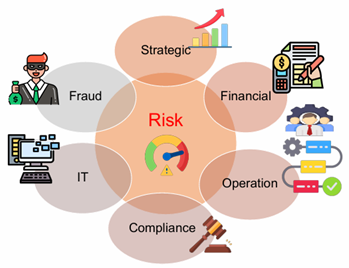
Risks to the Company's Business Operations
Risk Register
| Risk Name | Risk Characteristics | Consequences | Management Measures | Related Risk Factors |
|---|---|---|---|---|
| Customer/Consumer Behavior or Needs | Currently, consumers no longer view hospitals solely as places for treatment when ill, but rather as proactive healthcare providers, offering services such as annual health check-ups, nutritional planning, and aesthetic enhancements. There is an increased expectation for precision in treatment and prompt service. The adoption of technologies such as AI for disease diagnosis, robotic-assisted surgery, and Telemedicine has become a standard expectation among consumers. Furthermore, consumers utilize online information to search for, review, and select hospitals, necessitating businesses to prioritize transparency and build credibility through digital channels. |
|
| 729 · Description: Behavior or needs of customers / consumers · Info category: STRATEGIC_RISK |
| Government Policy |
|
|
| 730 · Description: Government policy · Info category: STRATEGIC_RISK |
| Cybersecurity risks | Being subjected to ransomware attacks or the theft of patients' personal data (Data Breach), as hospitals have numerous internal systems connected to applications and IoT devices. | The leakage of medical history data to the public severely damages reputation, causes treatment disruption (due to system failure and inability to access data), and may result in substantial lawsuits for damages under the PDPA law. | Implement multi-layer defense systems (Multi-layer Defense) and MFA authentication. Implement offline backup systems (Air-gapped Backup) and conduct annual security assessments (Vulnerability Assessment). | 732 · Description: Changes in technologies · Info category: STRATEGIC_RISK |
| Risk of new technologies replacing existing ones | The growth of Telemedicine and home diagnostic devices (Home Diagnostics) has made it unnecessary for patients to travel to the hospital for common illnesses. | The number of outpatients (OPD) in the non-severe disease group decreased, and revenue from hospital fees and basic service charges was lost. | Transforming risks into opportunities by establishing your own "Virtual Hospital" through investment in Wearable devices to provide remote patient monitoring services (Remote Patient Monitoring), thereby generating revenue instead of waiting for patients to visit the hospital. | 732 · Description: Changes in technologies · Info category: STRATEGIC_RISK |
| Competition / Increased competition / Ease of entry for new competitors |
|
|
| 1714 · Description: Competition risk · Info category: STRATEGIC_RISK |
| Environmental (Environmental - E) | Management of infectious and non-compliant plastic waste, greenhouse gas emissions from 24-hour cooling and electricity systems, and the scarcity of water resources | fined or ordered to suspend operations by regulatory bodies, rising energy costs, and reputational damage if chemicals or pathogens are released into the community. |
| 1717 · Description: ESG risk · Info category: STRATEGIC_RISK |
| Social Aspect (Social - S) | Personnel burnout, patient personal data breaches (PDPA), and inequality in access to healthcare services |
|
| 1717 · Description: ESG risk · Info category: STRATEGIC_RISK |
| Corporate Governance Aspect (Governance - G) | Corruption in the procurement of medicines and medical supplies, lack of professional ethics in exaggerated advertising, and a non-independent structure of the company's board of directors | Lack of confidence from shareholders, investors, and general service recipients | Develop an Anti-Corruption manual and a complaint channel (Whistleblowing) | 1717 · Description: ESG risk · Info category: STRATEGIC_RISK |
| Risks associated with the spread of infectious diseases | The outbreak of infectious diseases in the hospital business represents an external risk characterized by high uncertainty. It severely and broadly impacts the revenue structure, operational costs, and organizational image. Moreover, it is a risk that can be prolonged and recurrent, thus categorizing it as a strategic risk requiring long-term management. This risk stems from uncontrollable factors, such as community outbreaks and government policies. Hospitals are unable to directly prevent the onset of such diseases, and consequently, the duration, severity, or number of affected patients cannot be clearly predicted. Furthermore, multiple waves of outbreaks may occur. | The pandemic has impacted the hospital business in multiple dimensions, including fluctuating revenue, rising costs, personnel shortages, and potential decline in confidence, all of which affect the organization's long-term competitiveness and sustainability.
| Hospital business risk management measures during an epidemic should cover strategy, finance, personnel, operations, and communication to build resilience, mitigate impacts, and enhance long-term competitiveness.
| 1718 · Description: Pandemic risk · Info category: STRATEGIC_RISK |
| Shortage of or reliance on skilled labor |
|
|
| 739 · Description: Shortage or reliance on skilled workers · Info category: OPERATIONAL_RISK |
| Data Security or Computer Systems and Cyber Attacks |
|
|
| 744 · Description: Information security and cyber-attack · Info category: OPERATIONAL_RISK |
| Changes in regulations and laws related to business operations |
|
|
| 756 · Description: Change in laws and regulations · Info category: COMPLIANCE_RISK |
| Corporate Governance |
|
|
| 759 · Description: Corporate Governance · Info category: COMPLIANCE_RISK |
| Legal & Litigation Risk |
|
|
| 1723 · Description: Legal risk · Info category: COMPLIANCE_RISK |
| Revenue Volatility |
|
|
| 1725 · Description: Income volatility · Info category: FINANCIAL_RISK |
Risks to Securities Holders' Investment
Risk Register
| Risk Name | Risk Characteristics | Consequences | Related Risk Factors |
|---|---|---|---|
| Investment Risk for Securities Holders | It is a stock with a relatively small market capitalization and low trading volume. | Investors may find it difficult to buy or sell, and stock prices may exhibit high volatility even with minor buying or selling activity. | 2975 · Description: Risk from the stock having low free float, resulting in low trading liquidity · Info category: HOLDER_RISK |